Judge Jennifer McCoy Rules Herself Impartial: The Strawman Recusal Refusal
On August 10, 2026, Charleston Judge Jennifer B. McCoy denied the motion for her own recusal, answering only a 19-year-old clerkship point while leaving two false-pretense continuances, a six-month two-tier proposed-order track, and a 91-day recusal silence unaddressed.
Documents Overview
Charleston County Court of Common Pleas Case number: 2025-CP-10-05095
Filing Date: May 11, 2026
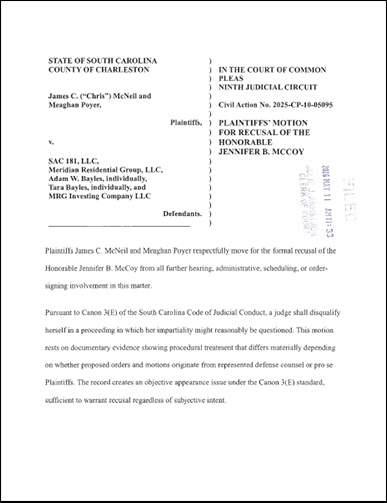
Document: Plaintiffs' Motion for Recusal of the Honorable Jennifer B. McCoy
Contents: Formal recusal motion under Canon 3(E) documenting the October 7, 2025 returned-orders directive, the fabricated-consent continuance of December 1, 2025, the false-predicate continuance of March 26, 2026, the five-business-day defense order pipeline of April 2026, and asymmetric gatekeeping of Plaintiffs' safety filings.
Charleston County Court of Common Pleas Case number: 2025-CP-10-05095
Filing Date: August 10, 2026 (electronically signed by Judge McCoy August 9, 2026)
Document: Form 4 Statement of Judgment Denying Plaintiffs' Motion for Recusal of the Honorable Jennifer B. McCoy
Contents: 92-word denial citing Mallett v. Mallett, 323 S.C. 141, addressing only the 19-year-old Dennis clerkship point and characterizing it as the entirety of Plaintiffs' evidentiary showing
Charleston County Court of Common Pleas Case number: 2025-CP-10-05095
Filing Date: November 20, 2025
Document: Plaintiffs' Response to Defense Request for Continuance and Motion for Protective Conditions
Contents: 87-page filing with exhibits documenting that Plaintiffs' consent to the December 19, 2025 continuance was expressly conditional, that both defense firms rejected every condition, and that court staff were nevertheless told Plaintiffs had consented; filed nine days before Judge McCoy signed the continuance without any protective condition
Charleston County Court of Common Pleas Case number: 2025-CP-10-05095
Filing Date: March 27, 2026
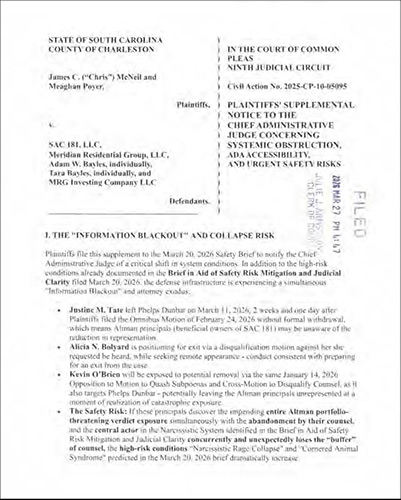
Document: Plaintiffs' Supplemental Notice to the Chief Administrative Judge Concerning Systemic Obstruction, ADA Access Denial, and Urgent Safety Risks
Contents: Notice with Exhibits A through F, including Exhibit C (the full court-staff email thread showing a Plaintiffs' safety filing labeled "ex parte" 62 minutes before the same thread accommodated defense counsel's Webex request) and Exhibit F (Judge McCoy's March 26, 2026 letter displacing the April 3, 2026 hearings on an administrative-assignment question that had been resolved when the Chief Administrative Judge convened and presided over the February 9, 2026 scheduling hearing)
Executive Summary
Judge Jennifer B. McCoy Denies a Motion For Her Own Recusal, Disregarding 4 of the 5 Core Arguments
On August 9, 2026, the Honorable Jennifer B. McCoy, Chief Administrative Judge of the Ninth Judicial Circuit, electronically signed a Form 4 Statement of Judgment denying the motion for her own recusal in McNeil & Poyer v. SAC 181, LLC et al., Case No. 2025-CP-10-05095. The ruling cites Mallett v. Mallett for the requirement of evidence of bias, then identifies just one of the many Plaintiffs arguments: that Judge McCoy clerked for Judge R. Markley Dennis, Jr. 19 years ago.
The other, more primary arguments? Disregarded.
Ignored as if not only they didn't happen, but Plaintiffs' arguments utilizing them didn't happen either.
But they did happen, and the 6-page Motion for Recusal of the Honorable Jennifer B. McCoy documents those arguments - and establishes a pattern:
- A continuance signed December 1, 2025 on a "consent" the email record shows was conditional and rejected;
- A second continuance issued March 26, 2026 on an administrative-assignment question her own Chief Administrative Judge had already resolved by convening the February 9, 2026 scheduling hearing;
- An October 7, 2025 directive returning pro se proposed orders with instructions to stop sending them, six months before a defense proposed order was signed within five business days;
- Chambers gatekeeping that falsely labeled a Plaintiffs' safety filing "ex parte" 62 minutes before accommodating a defense scheduling request on the same email thread.
What Judge McCoy's Ruling Answers, and What It Disregards
- Answered: The Dennis clerkship, which the motion presented as the "baseline condition," or in the framing of the analysis below, the floor under a much larger structure. The ruling treats the floor as the whole building.
- Disregarded: The December 1, 2025 continuance, signed at 10:50 AM while Plaintiffs' corrective filing sat in transit, memorializing a consent the November 20 Response and the email thread show was never given.
- Disregarded: The March 26, 2026 letter continuing the April 3 hearings on an assignment question resolved on February 9, 2026, when Chief Administrative Judge Van Slambrook convened and presided over the scheduling hearing in this case.
- Disregarded: The two-tier proposed-order track: pro se orders returned unsigned with a handwritten "motions to be set for hearing; do not need orders unless judge requests one," while a defense withdrawal motion with a proposed order attached was signed in five business days.
- Disregarded: The 91 days the recusal motion sat pending, three months in which every administrative act it challenged aged into history while its target held the pen.
What This Reveals: The "Justice Requires Status" model operating as designed. A two-tier architecture in which the same procedural act moves at different speeds and with different dignity depending on the representational status of the sender. South Carolina chooses its judges by legislative committee, one of only two states that does, and the National Center for Access to Justice scores South Carolina 18.14 out of 100 for self-represented access, behind 46 states. This now sits before the Supreme Court of the United States: a Writ of Certiorari in production from Appellate Case No. 2026-000919 asks whether a state court system violates Equal Protection by conditioning the validity and fidelity of identical procedural acts on whether a licensed attorney performed them.
The Record the Ruling Disregarded
Four documents, all filed, all timestamped, all public. Together they form the pattern the August 9 order declines to describe.
October 7, 2025: The Returned-Orders Directive
The Office of Chief Administrative Judge Jennifer B. McCoy returned Plaintiffs' Motion to Compel Insurance Disclosure with two proposed orders, one for redaction of personal identifiers, one compelling insurance disclosure. A checked box and a handwritten instruction accompanied the return:
"motions to be set for hearing. Do not need orders unless judge requests one." Staff initials: BS.
Plaintiffs complied.
The insurance disclosure motion, about the coverage picture in a case with five defendants, remained unresolved, and the growing inventory of unruled matters eventually drew the South Carolina Supreme Court's April 28, 2026 return-request letter in Appellate Case No. 2026-000919.
December 1, 2025: The Fabricated-Consent Continuance
The email thread is unambiguous and is reproduced in the November 20 Response. On November 18, defense counsel wrote the court scheduler that "all counsel for all Defendants... have consented" and later that "pro se plaintiffs have conditionally consented." Plaintiffs' actual November 18 message stated three conditions: expeditious rescheduling, no stay of discovery, and reservation of rights on sanctions. On November 19, both defense camps rejected every condition in writing. There was no consent; there was a conditional offer the defendants declined.
On November 20, Plaintiffs filed an 87-page Response with exhibits making this record explicit. On December 1 at 10:50 AM, Judge McCoy electronically signed SAC 181's proposed order granting the continuance, which recites that Plaintiffs "have advised the Court of their position" and imposes no protective condition of any kind. The order's predicate, consent, had been publicly rejected eleven days before the signature. The discovery issues Plaintiffs warned about followed: discovery responses due November 7 remained unproduced, and the blackout continued
March 26, 2026: The False-Predicate Letter
Attached as Exhibit F to the March 27 Supplemental Notice, Judge McCoy's March 26, 2026 letter displaced the four motions set for her April 3 roster, resting the continuance on an administrative-assignment question. But that question already had an answer of record: on February 9, 2026, Chief Administrative Judge Van Slambrook, the administrative head of the circuit's civil docket, had convened and presided over the scheduling hearing in this very case and issued the April 2 order.
The Supplemental Notice also documents what was happening in chambers the same week: Plaintiffs' Brief in Aid of Safety Risk Mitigation and Judicial Clarity, hand-filed March 20 per the court's own published instruction on every hearing notice, was characterized as "ex parte and not allowed" at 1:37 PM on March 23 by Beth Atkins, a staffer for a different judge; 62 minutes later, on the same thread, the same administrative channel accommodated defense counsel's Webex appearance request. Meanwhile Plaintiffs' ADA accommodations request, filed January 30, aged past two months without action.
April 2, 2026: The Five-Day Defense Pipeline
Six months after the October 7 directive told pro se Plaintiffs to stop submitting proposed orders, defense counsel Kevin M. O'Brien filed a Motion to Relieve Justine Tate as Counsel whose final sentence reads: "A proposed order for the Court's consideration is submitted herewith." The proposed order was signed and entered within five business days. Canon 3(E) disqualifies a judge whose impartiality "might reasonably be questioned."
A neutral observer reading these two tracks side by side, one for represented counsel, one for the pro se family, could reasonably conclude the practice governing proposed orders operates differently depending on the party's status.
The Strawman Architecture of the August 9 Ruling
Six Grounds In, One Ground Out
The May 11, 2026 recusal motion presented its case in six sections. The August 9 ruling responds to one of them, and describes that one as the entirety of the showing. The motion's own words establish what each section contributed:
- Section I, Procedural Asymmetry: the October 7 returned-orders directive measured against the five-day defense pipeline. The motion expressly noted that neither the October 7 instruction nor the defense withdrawal order is inherently problematic; the pattern, taken together, creates the reasonable appearance that administration operates one way for represented defense counsel and another way for pro se Plaintiffs.
- Section II, The Dennis Clerkship: presented as "the baseline condition for recusal," the historical proximity of Judge McCoy's legal foundation to chambers with a documented adversarial history involving Plaintiff McNeil's advocacy for victims of a targeted family matter.
- Section III, The Continuance Sequence: administrative delay extending the exact conditions under which documented clinical-severity harm accumulated, culminating in a PCL-5 PTSD score of 76 out of 80.
- Section IV, Asymmetric Gatekeeping: chambers staff filtering docket access by party identity, advancing informal defense requests while intercepting Plaintiffs' safety filings under a misapplied "ex parte" classification.
- Section V, The Expired Courtesy Window: the April 29, 2026 letter offering voluntary withdrawal with written confirmation by May 1, which passed without response, making the formal motion necessary.
- Section VI, Conclusion: the intersection of local political gravity, Altman family asset exposure, and asymmetric administration establishing that the Ninth Circuit environment lacks the structural neutrality the dispute requires.
The Mallett Frame
The ruling quotes Mallett v. Mallett, 323 S.C. 141, for the proposition that a party seeking disqualification must show some evidence of bias or prejudice, then concludes:
"The Plaintiff has failed to demonstrate evidence of judicial bias simply because Judge McCoy clerked for Judge Dennis 19 years ago."
Two features define the maneuver.
- Scope: the sentence replaces five documented sections with the one section the motion labeled the baseline.
- Standard: Canon 3(E) asks whether impartiality "might reasonably be questioned" by a reasonable observer aware of all the facts, an appearance standard. The ruling applies an evidence-of-actual-bias standard, the harder test, and then finds it unmet against the narrowest available predicate.
The strawman structure: attributing the weakest available version of the argument, answering that version, recording the answer as the resolution of the whole. The Form 4 fits the strawman structure.
The 91-Day Clock
The motion was filed and received May 11, 2026. It was denied August 9, 2026, six days after Judge Wheeler's August 3 dismissal with prejudice ended the underlying case. The sequence deserves plain statement: the recusal motion challenged the neutrality of the administrative environment; the motion sat for 91 days; inside that window, the case was assigned, heard, and dismissed with prejudice; the recusal denial then arrived, signed by its subject, in the quiet after.
Well, it was quiet. Now, "The Case of the Disappearing Woman" is before the United States Supreme Court. We suspect it will not stay quiet.
Systemic Validation: It’s Not Just Civil Court.
When institutions operate on a "Justice Requires Status" mental model, the bias doesn't stay confined to one type of case. It infects the entire pipeline.
Recently, the Rocket's Fight team was contacted by Kimberly Charlton, advocating for Casey Lee Combs, a pro se criminal defendant trapped in the exact same 9th Circuit administrative machinery, and who has also dealt with Judge McCoy.
The Casey Combs Parallel
In 2024, Mr. Combs received a maximum 10-year probation revocation sentence based heavily on four pending felony charges. In February 2026, those underlying charges were completely dismissed or reduced to a single misdemeanor.
Acting pro se, Mr. Combs filed a motion to vacate the revocation. He attached objective, indisputable evidence of his compliance: an official certificate of completion for a 26-session intervention program, SCDC records showing zero disciplinary infractions, and amended probation logs.
The Result? On August 4, 2026, Judge Jennifer McCoy issued a three-sentence summary order denying his motion "without necessity for a hearing." She disregarded the objective documentary evidence entirely, leaving an innocent man to serve an unjust, maximum sentence.
"The system treats pro se litigants as a nuisance to be swatted away, resulting in a total breakdown of institutional integrity. Accountability is desperately needed."- Kimberly Charlton, Advocate for Casey Lee Combs
The Mechanics of Erasure: Locked Out and Flattened
How does a judge so easily ignore objective, physical evidence attached to pro se motions? Perhaps in part because the South Carolina Court system can structurally degrade it before it ever reaches the bench.
The Lockout: South Carolina categorically bans pro se litigants from using the digital e-filing system, reserving it exclusively for licensed attorneys.
 The Degradation: Unrepresented citizens are forced to hand-file paper documents. The Clerk of Court then forces these filings through a 1-bit bitonal scanning pipeline that flattens photographs, destroys subtle text, and strips away all searchable native digital text data.
Whether it is erasing a woman from a photograph in a civil privacy lawsuit, or potentially degrading the subtle ink signatures on a criminal defendant's compliance certificates, the system mechanically alters the record based on representation status.
If you are a pro se litigant in South Carolina, you can see for yourself, with your own filings. We have launched a public utility for all South Carolina litigants to mathematically audit the degradation of their public records.
👉 Visit ScannerGate.com to test your docket filings today.
For questions about the recusal motion, the August 9 ruling, and the two-tier procedural record, contact:
Chris McNeil, Pro Se Plaintiff
Email: Click here to email with web form
Case: 2025-CP-10-05095, Charleston County Court of Common Pleas
Document Access
Motion for Recusal of the Honorable Jennifer B. McCoy
To Top
 Unable to view the pdf on your mobile device?
Download the PDF
Form 4 Statement of Judgment Denying Plaintiffs' Motion for Recusal (signed August 9, 2026, filed August 10, 2026)
To Top
 Unable to view the pdf on your mobile device?
Download the PDF
Plaintiffs' Response to Defense Request for Continuance and Motion for Protective Conditions (November 20, 2025)
To Top
 Unable to view the pdf on your mobile device?
Download the PDF
Plaintiffs' Supplemental Notice to the Chief Administrative Judge with Exhibits A-F including Judge McCoy's March 26, 2026 Letter (Exhibit F)
To Top
 Unable to view the pdf on your mobile device?
Download the PDF
Systems View: The Self-Judged Recusal
Iceberg Level |
In the August 9, 2026 Recusal Denial |
What It Reveals |
|---|
Events |
A judge signs a 92-word Form 4 denying the motion for her own recusal, citing the weakest of six presented grounds as the whole showing, six days after the case was dismissed with prejudice. |
That judges feel they can judge themselves without accountability in closed-loop South Carolina justice system. |
Patterns |
Two false-pretense continuances (December 1 fabricated consent; March 26 resolved-assignment question); a six-month two-tier proposed-order track; selective "ex parte" labeling applied 62 minutes before accommodating defense on the same thread; 91 days of silence on the recusal motion itself. An NCAJ self-representation score of 18.14 out of 100, behind 46 states; |
Differential treatment as an expression of the Ask<-->Harm Loop. |
Structures |
Legislative selection of judges by a committee composed largely of lawyers who appear before the judges they elect; a two-tier filing architecture that reserves e-filing for attorneys; self-judged recusal as default design. |
"Justice Requires Status" operating as load-bearing infrastructure: representation status determines procedural speed, dignity, and visibility. |
Mental Models |
Old: "Justice Requires Status" (expressed here as "The system polices itself; a judge's word that she is impartial settles the question.") New: "Documented patterns judged by the documented record are the measure; every actor in a healthy system welcomes outside review of its own conduct." |
From status-based trust to record-based trust, the same shift Conscious Co-Stewardship asks of landlords and owners asked here of the bench. |
Strategic Thought Leadership Intervention: New Mental Models |
Old: The "Justice Requires Status" leaves the higher values of justice, fairness, integrity, and equity unfulfilled. These values would be better satisfied with the Thought Leadership Position Mental Model "Designing from the Most Vulnerable Member Point of View Benefits Everyone Who Uses the System." |
South Carolina may have the weakest legal economy in the US - the lowest lawyer density of any state and the lowest lawyer income per capita of any state. When an institution loses public trust, people don't want to use it. Regain the public by redesigning for the vulnerable because it benefits everyone through the cut curb principle. |
Frequently Asked Questions
↩ Back to Where You Were⤴ Up to the Top
Why did Plaintiffs file a motion for Judge McCoy's recusal?
The motion was filed because a documented, two-tier system of justice had emerged in the case. In October 2025, early in the case, Judge McCoy's chambers returned pro se proposed orders un-signed with instructions to stop sending them. But, around 6 months later, the court signed and filed a represented defense attorney's proposed order in just five business days. Additionally, the motion cited continuances granted to the defense under false pretenses and the asymmetric interception of Plaintiffs' safety filings.
↩ Back to Where You Were
| ▲ FAQ Menu
How did Judge McCoy address these documented patterns in her ruling?
She didn't. Instead, Judge Jennifer B. McCoy utilized a "Strawman" tactic. Out of a detailed, six-section
motion, she isolated a single point - a 19-year-old clerkship connection - and framed it as if it were the only evidence Plaintiffs presented.
By answering the weakest available version of the argument, she dodged addressing the severe administrative and procedural disparities documented on the record, including 2 defense-favoring continuances under demonstrably false pretenses.
↩ Back to Where You Were
| ▲ FAQ Menu
Is this kind of summary denial without reviewing objective evidence unique to this civil case?
No. This is a systemic feature of the 9th Judicial Circuit's treatment of pro se (unrepresented) parties.
As seen in the criminal case of Casey Lee Combs, Judge McCoy summarily denied a pro se motion to vacate a 10-year probation revocation without a hearing, completely bypassing objective, attached documentary evidence showing that the underlying felonies triggering the revocation had been dismissed.
↩ Back to Where You Were
| ▲ FAQ Menu
How does the South Carolina e-filing ban for self-represented parties affect outcomes for cases like this and Casey Combs's?
Because pro se litigants are locked out of digital filing, they are forced to submit paper that the court can and often does scan using degrading, 1-bit bitonal settings.
This means judges often receive pro se evidence that is visually corrupted and completely unsearchable.
A judge cannot hit "Ctrl+F" to search a pro se brief, but they can easily copy-paste from a digitally filed defense brief, as apparently happened in Judge Wheeler's ruling. This technological disparity practically guarantees that a judge will lean heavily on defense narratives while ignoring pro se physical evidence.
↩ Back to Where You Were
| ▲ FAQ Menu
Why is it significant that a judge rules on their own recusal motion?
It highlights the "
Justice Requires Status" mental model where the system exclusively polices itself. When a judge is allowed to rule on whether their own administrative environment is biased, it requires them to subjectively grade their own homework. An objective, systemic audit reveals that this self-policing mechanism almost universally defaults to protecting the institution rather than the vulnerable litigant.
↩ Back to Where You Were
| ▲ FAQ Menu
What is a "Strawman" ruling, and how did Judge McCoy use it here?
A
strawman argument is a logical fallacy where someone ignores a person's actual position and substitutes an exaggerated or misrepresented version of that position to make it easier to attack.
In this case, Judge McCoy's August 9 ruling isolated a single, minor point from Plaintiffs' motion (a 19-year-old clerkship connection) and framed it as the
only reason Plaintiffs were asking for recusal. By doing this, she avoided addressing the five severe, documented administrative disparities actually at the heart of the motion.
↩ Back to Where You Were
| ▲ FAQ Menu
What were the actual, documented arguments that Judge McCoy ignored?
The
motion for recusal was based on a documented pattern of structural bias and a "two-tier" justice system. Judge McCoy's ruling completely ghosted all five of these primary arguments:
- The Asymmetrical Order Pipeline: The court returned pro se proposed orders unsigned, instructing Plaintiffs to stop sending them, but signed and filed a defense attorney's proposed order in just five business days.
- A Fabricated-Consent Continuance: On December 1, the court signed a continuance for the defense based on the false claim that Plaintiffs had consented.
- Intercepted Safety Filings: On March 26, chambers staff intercepted and blocked a pro se filing detailing systemic obstruction, falsely calling it "ex parte." Just 62 minutes later, on the exact same email thread, staff cheerfully accommodated a scheduling request from the defense.
- The 91-Day Delay: The court sat on the recusal motion for 91 days, waiting until six days after the underlying case was dismissed by a different judge before finally issuing a denial.
- ADA Obstruction: The court ignored a clinically supported ADA accommodation request for digital filing for over 117 days, forcing Plaintiffs to remain subject to the degrading 1-bit bitonal paper scanning pipeline.
↩ Back to Where You Were
| ▲ FAQ Menu
How can a judge just ignore objective facts on the public record?
They can ignore facts because the
structures of the South Carolina justice system currently allow (and even incentivize) them to do so without immediate accountability.
When a court operates on a
"Justice Requires Status" mental model, it intuitively views unrepresented (
pro se) litigants as a nuisance to be managed rather than citizens with equal rights to be heard.
Because South Carolina utilizes a self-policed recusal system where judges gets to grade their own homework and rule on whether their own administrative environments are biased, the system practically guarantees that judges will feel insulated enough to deploy these "Strawman" tactics without fear of professional consequences.
↩ Back to Where You Were
| ▲ FAQ Menu
What happens when we apply the "Most Vulnerable Member for All" (MVM-4-All) paradigm instead?
When you design a system to be fully accessible and accountable to its most vulnerable members (like an unrepresented litigant facing eviction), you eliminate the procedural friction that allows these omissions to hide.
Instead of burning resources guarding procedural hurdles to protect the institution, an MVM-4-All court actively engages with native digital evidence and addresses systemic disparities head-on. This "
Power With" model (as opposed to the "Power Over" model) doesn't just help the vulnerable; per the
cut-curb principle it creates a faster, more resilient, and highly prestigious court for every single person who uses it.
↩ Back to Where You Were
| ▲ FAQ Menu
How can the structural issues of pro se< evidence degradation through the forced paper intake process and frequent (per the McNeil v SAC 181, LLC et al. experience of pro se<plaintiffs) use of 1-bit bitonal scanning be addressed, and how can a pro self-represented litigant in the South Carolina state-level courts know how much their filings were degraded?
To combat the systemic destruction of
pro se evidentiary fidelity—where the court's intake pipeline purposefully flattens high-resolution photographs, strips away searchable native text, and seemingly frequently forces evidence into a degraded 1-bit bitonal format, advocates have launched a self-serve diagnostic tool. You can now mathematically audit the degradation of your public records by visiting
ScannerGate.com.
↩ Back to Where You Were
| ▲ FAQ Menu