Self-Represented Tenant is Actually a Consultant Studying the System
Shedding the "Vulnerable Tenant" disguise, the Systems Analyst Asks the Court to Confront Institutional Betrayal, and Sets the Tone for addressing Charleston’s Housing Crisis
Document Overview
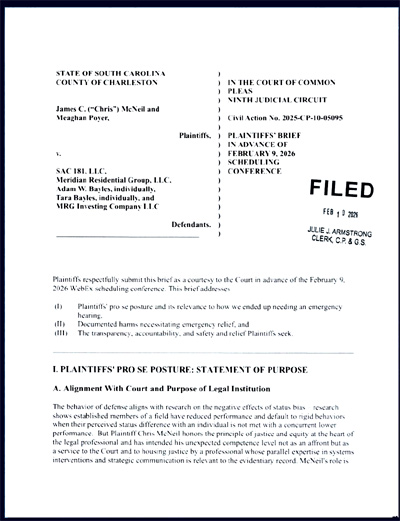
Charleston County Court of Common Pleas Case number: 2025-CP-10-05095
Filing Date: February 9, 2026 (Entered Feb 10)
Document: Plaintiffs' Brief in Advance of February 9, 2026 Scheduling Conference
Contents: Statement of Purpose; Analysis of Status Bias in Legal Dynamics; Documentation of Retaliatory Harm; Requested Outcomes for Judicial Efficiency.
Executive Summary
The February 9 2026 Hearing Brief documents the foundational "Status Swap" in McNeil and Poyer v. SAC 181, LLC et al. It evoked the concept of Status Bias to help explain both the incompetent filings and the apparent psychological abuse campaign of Phelps Dunbar and Resnick & Louis defense attorneys in this case that led to a nervous breakdown and severe PTSD test score (76 out of 80 in PCL-5 test). It also clarified the purpose of the pro se role as a tool of a Systems Analyst conducting a study - a tool called the Most Vulnerable Member (MVM) method.
By citing research on Status Bias, the brief identifies how credentialed professionals can default to rigid, adversarial behaviors when faced with a higher performing self-represented party than their perceived status differential demands.
It also brought light to how McNeil applied the MVM methodology by "occupying the role of the unrepresented vulnerable tenant seeking justice ... while simultaneously documenting the systemic friction points, institutional failures, and coordination patterns that would otherwise remain invisible."
This dual perspective was necessary to perform such a system study in this context and the wisdom of multiple perspectives is already supported by McNeil's foundation work in Strategic Thought Leadership.
It is worth noting that the brief clarifies for the court "This work is conducted with full respect for and adherence to the South Carolina Rules of Civil Procedure." Indeed, the systems thinking consultant role aligns with empowered judicial decision-making in that this type of consulting can help make complex systems understandable and make their leverage points for positive change more visible.
This filing helps make complex systems understandable with a frame of reference that makes sense of the defense's refusal to acknowledge documented harms (including unauthorized publishing and mass syndicated distribution of private family life images, retaliatory eviction in a heat wave, and postal fraud), and instead to weaponize the legal process with organized, multi-party harassment and gaslighting to the point of triggering a nervous breakdown in a high-functioning individual.
The brief accomplishes this by:
- Revealing the Whistleblower function in order to better shield the party documenting systemic flaws from retaliation
- Invoking McNeil's court history as an expert witness in high-tech communications;
- Aligning with the principles of justice and fairness at the heart of the legal system as a friend of court from the separate but litigation-relevant fields of systems interventions and strategic communications
- Serving the judicial need for clarification of an intricate case by chunking up from events to patterns and structures, as well as the mental models behind all of it;
- Pointing out he would have hired a law firm months ago but for the Institutional Betrayal experienced due to Phelps-Dunbars' and Resnick & Louis' behavior in this case necessitating a higher standard of due diligence to ensure a litigation partner is values-aligned;
Status Bias as Strategic Instrument: The Science of the Script Flip
The Dynamics of a Status Swap through a Reveal Event
On February 9, 2026, Plaintiff Chris McNeil provided this scheduling-hearing-guiding brief to the Charleston County Common Pleas Court to support executing what social psychologists call a Permanent Status Reversal - a shift from the defense attorneys' perception of a self-represented tenant as a lower status role to their deference to the expertise-based status of a recognized systems interventionist, expert witness, and strategic communications consultant.
This report provides the academic scaffolding for why that reversal is permanent, and why the court's updated frame of reference is grounded in independently verifiable methodology.
The research establishes three interlocking conclusions:
- Status bias is a documented, predictable cognitive process that can be strategically utilized rather than merely suffered.
- A well-timed identity reveal from low-perceived-status to demonstrated expert power creates a "positive expectancy violation" that elevates the revealer higher than if they had started in the high-status position.
- The high-status party's performance degrades measurably and predictably once the hierarchy becomes unstable.
The Theoretical Foundation — Why Status Bias Is Predictable
The Stereotype Content Model: Status → Perceived Competence
The foundational research is Fiske, Cuddy, Glick, and Xu's Stereotype Content Model (SCM), published in the Journal of Personality and Social Psychology (2002). The SCM demonstrates that people evaluate others along two primary dimensions: warmth (intent) and competence (capacity). Crucially, the research establishes that perceived status is the primary predictor of perceived competence—not actual demonstrated ability.Application to litigation: A pro se litigant enters the courtroom pre-coded as "low status" under the SCM. Defense attorneys, by contrast, arrive pre-coded as "high status" through institutional affiliation (Phelps Dunbar, Resnick & Louis). This creates an automatic competence gap in the minds of all observers - including, potentially, the judge - that has nothing to do with the actual quality of the arguments.
This is not speculation. Budzinski's 2025 Baylor Law Review article, "Power and Equity in Pro Se Procedure," documents this precise dynamic:
Budzinski establishes that pro se litigants receive less generous treatment not because their cases are weaker, but because of their perceived social identity and lack of power. The "pro se" label itself triggers status-based processing that systematically disadvantages the unrepresented party. Procedural rules assume the presence of lawyers, creating structural inequity that compounds the cognitive bias.
The Power Taxonomy: Expert Power vs. Positional Power
French and Raven's seminal taxonomy of social power (1959) identifies five bases: Legitimate, Reward, Coercive, Expert, and Referent (with Informational added by Raven in 1965). The critical distinction for this analysis is between
- Positional Power (Legitimate, Reward, Coercive—derived from role) and
- Personal Power (Expert, Referent—derived from competence and character).
Defense attorneys operate primarily on Legitimate (Positional) Power: the authority derived from bar membership, firm affiliation, and institutional standing. This power is borrowed from the institution and is inherently fragile. It collapses when the institution's credibility collapses.
The systems interventionist operates on Expert Power: influence based on demonstrated skill, knowledge, and analytical capability. Expert power is personal and portable. It cannot be taken away by disbarment, firm dissolution, or institutional scandal. Once demonstrated, it persists.
The strategic implication: When Expert Power is revealed in a context where only Positional Power was expected, the dynamics shift permanently. The positional-power holder cannot "un-know" what the court has seen. The expert-power holder cannot be "re-minimized."
Judicial Cognition and the Science of Framing
Guthrie, Rachlinski, and Wistrich's landmark study, "Inside the Judicial Mind" (2001), examined how 167 federal magistrate judges processed information when faced with five specific cognitive illusions: anchoring, framing, hindsight bias, the representativeness heuristic, and egocentric biases.
The research concluded that all five cognitive illusions significantly influenced judicial decision-making. While the judges showed a higher resistance than laypersons toward framing and representativeness, being human, they were found to be susceptible to anchoring, hindsight bias, and egocentric bias.
This brief offered the research openly, trusting that a court armed with this awareness is better positioned to deliver the justice both parties are entitled to.
Application to procedural strategy: A party who understands the mechanics of judicial anchoring can help judges see through smokescreens such as defense posturing that minimizes the frame of the case.
The February 9 brief brought this dynamic into the open, and the defense cannot undo it because a court that has adopted a more sophisticated and accurate frame of reference generally cannot be "un-anchored" to a simpler, less complete one.
The cannot unsee what they have seen.
For more information about this Brief or McNeil and Poyer v SAC 181, LLC et al, contact:
Chris McNeil, Pro Se Plaintiff
Email: Click here to email with web form
Case: 2025-CP-10-05095, Charleston County Court of Common Pleas
Document Access
Plaintiffs' Brief in Advance of February 9, 2026 Scheduling Conference
To Top
 Unable to view the pdf on your mobile device?
Download the PDF
Systems Analysis
Iceberg Level |
The Old Model (Observed Behavior) |
The New Model (Systemic Solution) |
Outcome for Housing Justice |
|---|
Events |
Defense labels criminal notice as "threats"; ignores imagery evidence. |
"Status Swap" Brief defines the dysfunctional behavior and concurrent poor quality litigation performance of defense as explainable by Status Bias. |
Re-centers the hearing on facts rather than character smears. |
Patterns |
Defaulting to rigid, adversarial "Lawfare" when challenged by pro se competence. |
Application of systems research to predict and name defense maneuvers. |
Exposes the "Justice-Harm Loop" to the Court's observation. |
Structures |
Asymmetric information and resource gaps used to force exhaustion. |
Request for ADA Case Manager and verified communication logs. |
Levels the field by enforcing structural transparency. |
Mental Models |
Old: "Litigation is a game of status and attrition." |
New: "Litigation is a diagnostic study of system resilience." |
Shifts the paradigm from "Role-Based Status" to "Skills-Based Status" leading to an "Evidence Frame" |