The Emergency Health Motion They Denied
South Carolina's judge selection process enables vulnerability to capture. How a denied emergency continuance and related, ignored-for-4-months ADA accommodations motion exposed the human cost of such capture through the impact on a disabled pro se litigant.
Document Overview
Charleston County Court of Common Pleas, Case No. 2025-CP-10-05095
Filing Date: May 26, 2026
Document: Plaintiffs' Emergency Motion for Health Continuance of the May 28, 2026 Hearing Pending Rulings on Federally Mandated ADA Accommodations and the Pending Motion for Leave to File Second Amended Complaint
Contents: Emergency motion, declaration-based health record, ADA-delay chronology, documentary table contrasting defense narrative with record evidence, SC access-to-justice analysis, and federal ripeness framing tied to Plaintiffs' pending ADA and access claims.
Executive Summary
This emergency motion was first shared on Friday May 22, 2026 as a courtesy copy with counsel and Judge Wheeler's quarters. Judge Wheeler denied it. It was filed on May 26, 2026, two days before a scheduled hearing that Plaintiffs argued could not be safely or lawfully conducted while a federally mandated ADA accommodation request had remained pending for 117 days and a motion for leave to file the Second Amended Complaint had remained pending for 214 days. The motion frames the requested continuance as a medical necessity rooted in documented PTSD escalation, prolonged court silence on foundational protective motions, and coordinated defense minimization of an eight-count fraud and privacy case.
The filing lays out a compact evidentiary record showing how procedural delay, narrative minimization, and institutional betrayal combine to create a court-access crisis for a disabled pro se litigant. The motion also places that crisis inside a larger South Carolina pattern, including poor access to justice for self-represented parties metrics and a court structure that, in practice, has made it easier for repeat institutional actors to obtain procedural access than for disabled pro se litigants to obtain baseline accommodations and timely rulings.
What the Motion Shows
- Health and procedure are linked: The motion shows that PTSD escalation is intensified by unresolved ADA requests, prolonged motion silence, and repeated pressure to proceed without baseline procedural safety.
- The defense narrative is tested against the record: A core table contrasts the recurring description of the case as a simple deposit dispute with documentary evidence of falsified postal evidence, unauthorized image publication, retaliatory eviction, commingling issues, and PMIC-related obstruction.
- The hearing risk was identified in advance: Plaintiffs told the Court before the hearing that forcing participation without resolving the ADA predicate had become medically unsafe.
- The filing preserves a federal-facing record: The motion expressly situates the cumulative posture inside Title II, access-to-courts, and broader civil-rights framing without abandoning the possibility of a lawful state-court correction.
What This Reveals: By the time this motion was filed, the PTSD escalation it describes was already underway; the filing simply put words and evidence to a crisis that the Court’s own delays and defense conduct had helped create. Moving forward with the hearing despite those warnings now documents, in the record, how a disabled pro se litigant’s health‑based pleas were treated inside this system.
How the SC Judge Selection System Makes SC Judge Capture More Probable
South Carolina is one of the few states where the legislature elects judges, and that structure channels judicial advancement through relationships with politically connected lawyers and legislators rather than through direct accountability to court users. In practice, that architecture makes it easier for courts to absorb the preferences and tone of repeat bar actors while self-represented litigants experience friction, delay, and human cost.
This motion matters because it shows that structural reality at the human level. When a disabled self-represented litigant files a documented emergency request explaining why participation has become medically unsafe, and the system still moves forward without first resolving the nearly 4-month old and Federally mandated ADA predicate, the record begins to call for Federal level correction.
And, read along, because a system that is designed to add friction to access for its most vulnerable members is also sub-optimal for all of the roles it serves - even the attorneys.
Where Courts Support Self‑Represented People, Lawyers Thrive Too
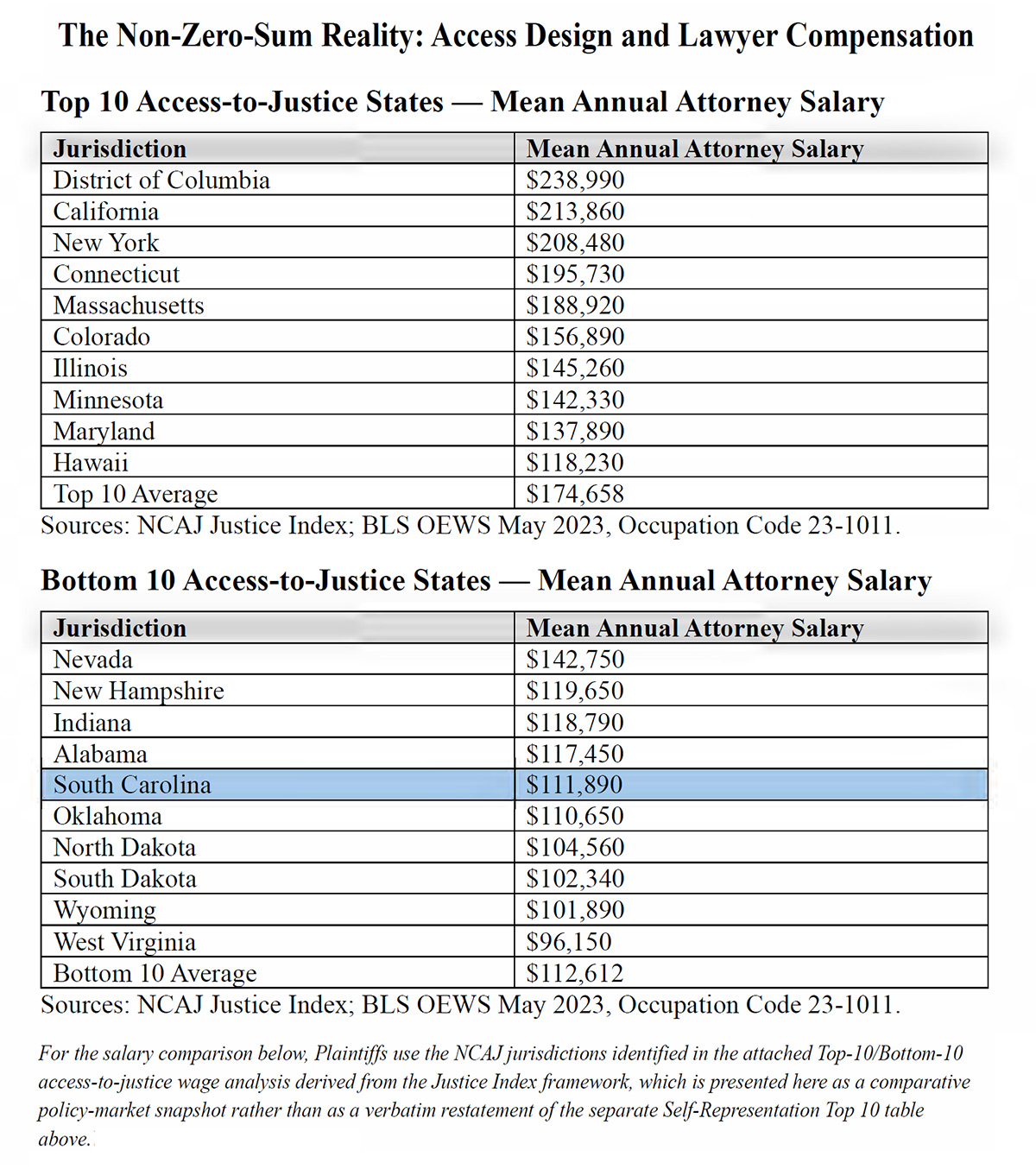 In the National Center for Access to Justice’s Self‑Representation Index, the states that invest in real help for unrepresented litigants also tend to sustain stronger civil legal ecosystems. In Plaintiffs’ Emergency Health Motion, Exhibit C’s BLS‑paired wage analysis shows that the ten best‑performing civil‑justice states pay their lawyers materially more, on average, than the ten worst‑performing states, even while those top‑ten states implement far more self‑help safeguards and disability‑access policies.
A well‑designed system reduces wasteful "failure demand," channels cases to counsel when counsel adds the most value, and pays those lawyers better for work that actually advances justice instead of processing preventable crises.
The Emergency Health Motion argues for a court system built from the vantage point of the Most Vulnerable Member - the self‑represented tenant trying to navigate a complex institutions - serves all system users and members better, because that lens reliably surfaces the design fixes that make the system more usable for everyone.
The Justice Index dataset and BLS‑paired wage analysis in Exhibit C imply that states that adopt robust self‑representation, disability‑access, and language‑access policies do not devalue professional advocacy; they create cleaner dockets, fewer unnecessary hearings, and more capacity for lawyers to do high‑leverage work for clients who truly need full‑service representation - and they tend to be paid more for that work.
In that kind of system, a motion like this one is a routine, well‑supported request in a court that expects to keep its most vulnerable members safe.
South Carolina’s Disability Access Record Makes This Motion Predictable
The Emergency Health Motion sits inside a documented statewide disability-access failure that national researchers have already quantified. The National Center for Access to Justice’s Disability Access Index scores South Carolina at 17.5 out of 100 - with 44 states performing better and only six scoring lower - and catalogs specific gaps such as:
- The absence of a published disability-access strategic plan,
- The absence of statewide reporting on ADA accommodation requests and denials, and
- The lack of clear, judiciary-level benchmarking on how people with disabilities can request accommodations or complain when access fails.
South Carolina’s Race to the Bottom
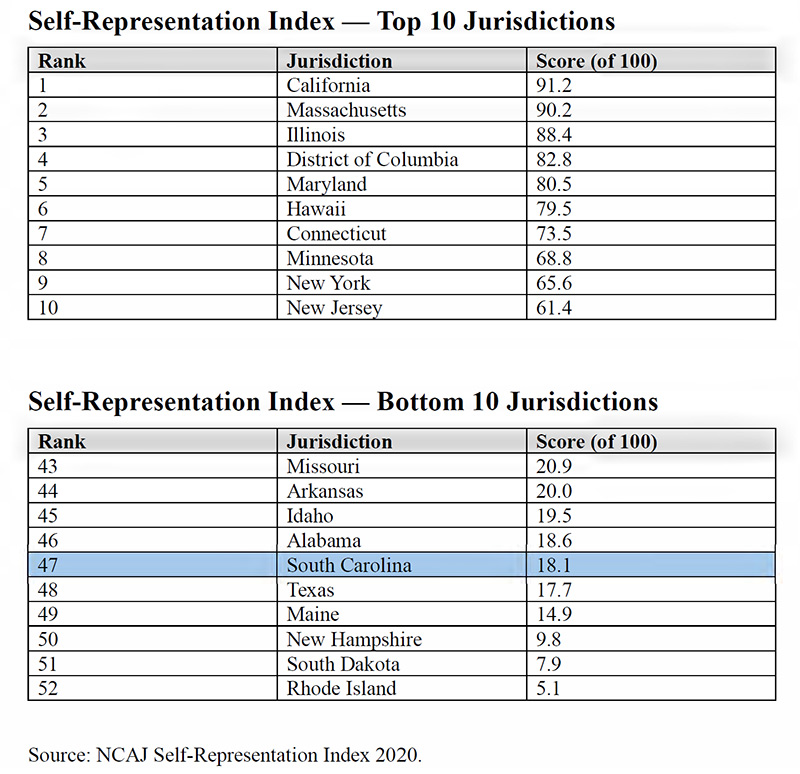 South Carolina’s overall Justice Index score is 23.69 out of 100, with 43 states (that include DC and Puerto Rico) scoring higher and SC's Justice Index score for Self‑Representation score is 18.14, with 46 states scored higher, placing it in the bottom handful of jurisdictions nationwide for both.
In the Emergency Health Motion featured here, Plaintiffs tie that design failure directly to clinical harm: a 76/80 PCL‑5 PTSD score, a 215‑day delay on a basic amendment motion, and more than 117 days of silence on an ADA accommodation request in a case involving falsified postal evidence and multi‑platform privacy violations.
For questions about this motion and the May 28, 2026 hearing, contact:
Chris McNeil, Pro Se Plaintiff
Email: Click here to email with web form
Case: 2025-CP-10-05095, Charleston County Court of Common Pleas
Document Access
Plaintiffs' Emergency Motion for Health Continuance of the May 28, 2026 Hearing
To Top
 Unable to view the pdf on your mobile device?
Download the PDF