18 Error Ruling by Judge Wheeler, Error 12: Half of Rule 9(b)
The Order quotes Rule 9(b)’s first sentence, particularity, and dismisses the fraud count for pleading knowledge and intent generally. The rule’s second sentence expressly authorizes pleading knowledge and intent generally.
Documents Overview
Charleston County Court of Common Pleas Case number: 2025-CP-10-05095
Filing Date: August 3, 2026
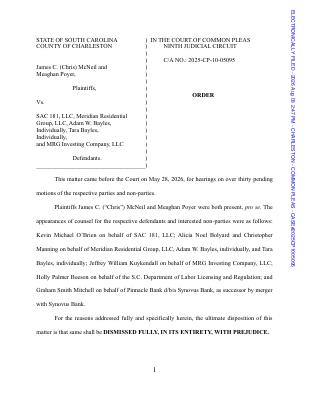
Document: Order of Dismissal With Prejudice, signed by Judge William W. Wheeler, III (29 pages)
Contents: Dismisses Counts II, IV, and V under SCRCP 12(b)(6), denies leave to file the Second Amended Complaint, and dismisses Counts I, III, and VI with prejudice as a Rule 11 sanction resting on six findings of fact. Docket sequence P1A58, filed 67 days after the May 28, 2026 hearing.
Charleston County Court of Common Pleas Case number: 2025-CP-10-05095
Filing Date: August 12, 2026
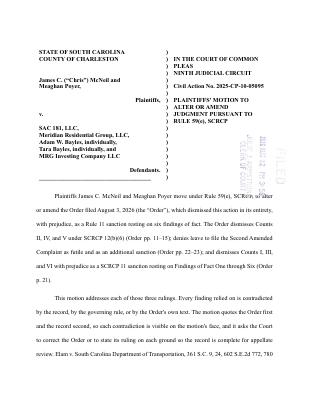
Document: Plaintiffs’ Motion to Alter or Amend Judgment Pursuant to Rule 59(e), SCRCP
Contents: Twelve sections quoting the Order first and the record second, so each contradiction shows on the motion’s face. Includes the provenance study measuring how much of the Order’s Analysis matches defense briefs verbatim. Docket sequence P1A62.
Charleston County Court of Common Pleas Case number: 2025-CP-10-05095
Filing Date: August 14, 2026
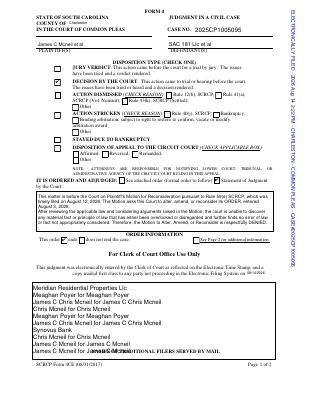
Document: Order Denying Plaintiffs’ Rule 59(e) Motion (Form 4)
Contents: The denial arrived two days after the motion, within 48 hours, on a form order. Every question the motion posed remains standing, now preserved for the Supreme Court of South Carolina and the federal courts. Docket sequence P1A63.
Executive Summary
What the Order States
“… the circumstances constituting fraud or mistake shall be stated with particularity.” … “Allegations of knowledge, falsity or intent to deceive are alleged in a presumptive or conclusory manner.”
Order of August 3, 2026, pp. 11–12: the rule quoted, then the dismissal rationale
What the Full Rule States
Rule 9(b), SCRCP, holds two sentences. The second: “Malice, intent, knowledge, and other condition of mind of a person may be averred generally.” The Order quotes the first sentence, omits the second, and dismisses the fraud count for pleading condition-of-mind elements generally, the exact method the omitted sentence authorizes. The rule the court cited defeats the ruling the court made; only the half-quotation lets the two coexist.
The Pattern: Authority Halved in Transit
The provenance study locates the 9(b) quotation inside text matching SAC 181’s brief. A rule read from the reporter arrives whole; a rule adopted from an advocate’s brief arrives edited for the advocate’s purpose. The half-rule then performed dispositive work on Count II, alongside Errors 1 and 2.
Verify It Yourself
- Order, pp. 11–12, docket sequence P1A58
- Rule 9(b), SCRCP, two sentences, at sccourts.org
- Rule 59(e) Motion, Section V and Section XII, docket sequence P1A62
Understanding This Error Through the Iceberg Model
Events: What Happened
The Order dismissed the fraud count for generally-pleaded knowledge and intent after quoting only the first sentence of Rule 9(b), while the rule’s second sentence expressly permits knowledge and intent to be averred generally.
Patterns: The Error Class and Its Direction
Authority halved in transit, the same mechanism as the Karppi standard in Error 7: the quoted half supports dismissal, the omitted half forbids it, and the omission decides the case.
Structures: The System That Produces This
A represented party’s counsel would invoke the second sentence in one line; the structure leaves a self-represented party to discover, post-judgment, that the court ruled on half a rule. This error lives inside structures larger than one courtroom. South Carolina selects circuit judges through legislative election, a process the organized bar knows intimately and ordinary citizens touch rarely. The state’s e-filing system accepts filings from members of the South Carolina Bar and routes self-represented parties to paper, email, or the clerk’s counter, a two-tier architecture measurable on this docket: defense filings enter through the electronic gate while Plaintiffs’ filings arrive by the paths left open to them. The state ranks 9th lowest on the Justice Index, 6th lowest in access for self-represented litigants, and last among all states in attorney count (Forehand, Navigating Rough Waters, 74 S.C. L. Rev. 863). Structures produce outcomes without requiring anyone’s conscious intent, which makes them the correct target for repair.
Mental Models: What Makes It Feel Normal
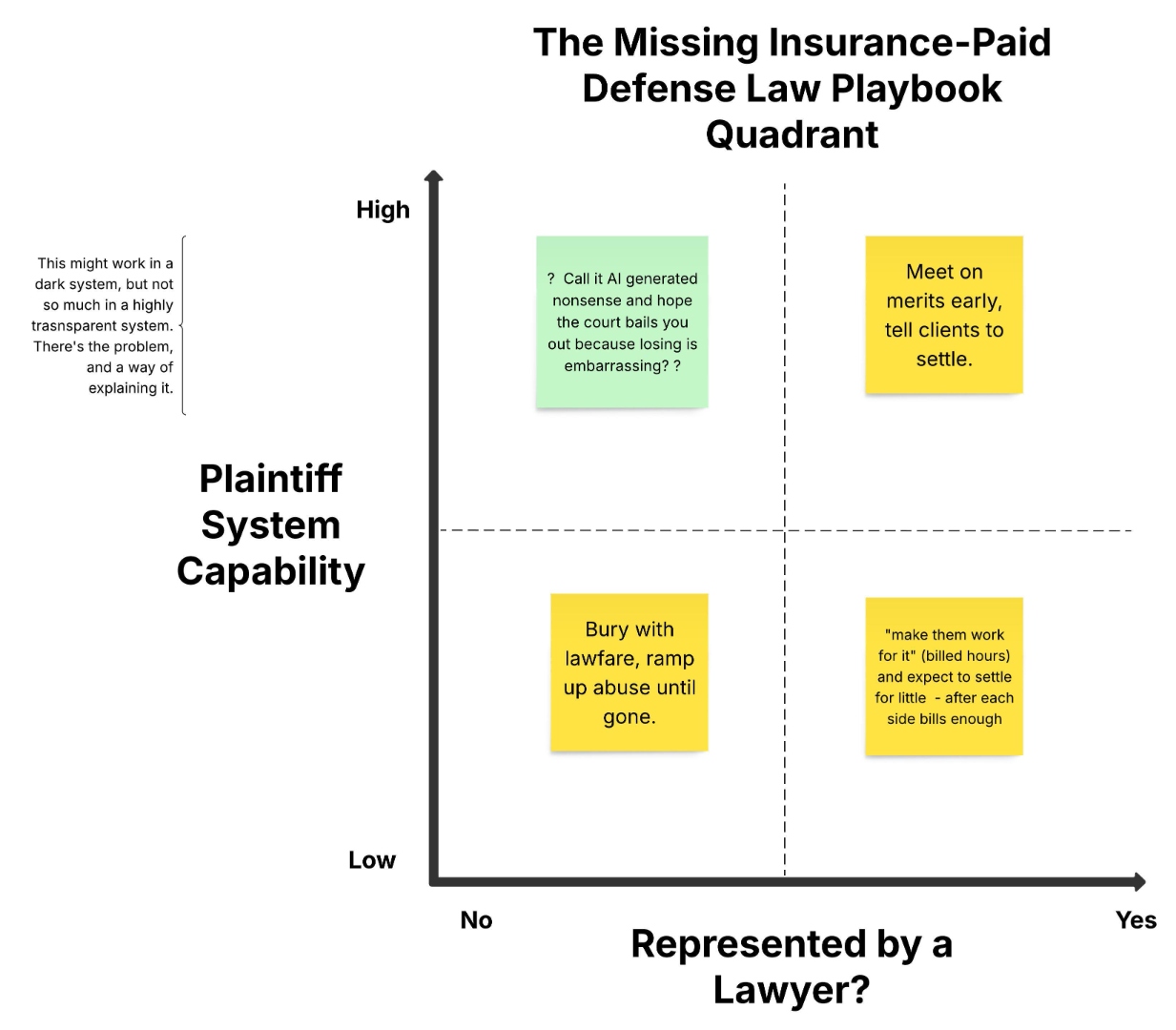
A one-line rule, half-quoted in a dispositive order, measures exactly how much scrutiny the underlying model expected the ruling to receive. Beneath the structures sit two mental models. The first: Justice Requires Status, the operating assumption that argument strength tracks the arguer’s credentials, so a filing from a self-represented party arrives pre-discounted. The second: Billed Hours First, the insurance-paid defense playbook in which motion volume and delay generate revenue whether or not any motion wins. The Playbook Autopsy quadrant below maps the playbook by plaintiff capability and representation status, and exposes the missing quadrant: the defense bar has an established play for every situation except a high-capability self-represented plaintiff operating in a transparent system. This case sits in that missing quadrant, which explains the “call it AI” improvisation and the one-directional errors catalogued in this gallery.
The Path Back Up: The Seven Level Pullamid
Systems thinking drills down from events to mental models. Strategic Thought Leadership then climbs back up: change the mental model and the structures, patterns, and events above it reorganize. The Seven Level Pullamid maps that path across Core Mission, Identity, Values, Mental Models, Skillset, Pull, and Pullfillment. Two levels do the heavy lifting here.
Values. The baseline position runs on power, success, and status, with confidence, justice, fairness, and integrity going unmet. The Thought Leadership Position meets those unmet values directly: integrity, justice, fairness, compassion, and wisdom, and, paradoxically, delivers more durable status than status-seeking ever did.
Mental Models. The baseline model reads: if we obstruct the vulnerable, it protects our power, which means we hold special status over others. The MVM4-All replacement reads: if the system supports access for the vulnerable, it works better for everyone, which means everybody wins with a better system. Reciprocity creates emergent value; obstruction destroys it. The full model appears in Plaintiffs’ Position Paper MVM-4-All (June 16, 2026).
Applied here: the replacement model reads rules whole because the court’s authority rests on the rules being real constraints rather than quarry for selective quotation.
To the Supreme Court
Plaintiffs served a Petition for Writ of Certiorari on August 19, 2026, and it entered the docket August 20, 2026 (docket sequence P1A65). The petition asks the Supreme Court of South Carolina to review the questions this ruling raised and the two-day, 48-hour form denial that closed the Rule 59(e) door.
Then the docket added its own exhibit. Plaintiffs emailed the petition to the court as a born-digital PDF: searchable text, intact metadata, verifiable provenance. The court printed that digital file onto paper, scanned the paper back into a computer, and docketed the scan. Of the resulting 117 pages, 115 render as black-and-white bitonal images and two render as grayscale. The text layer, the metadata, and the hash chain all died in the round trip. The same act proves the court receives filings by email and can docket them, which happens to be the exact capability Plaintiffs’ pending ADA accommodation request asked the court to acknowledge. The court demonstrated the capability while degrading the document. You can read about the full measurement study of 37 docket artifacts and 1,493 pages at housingjusticeaudit.com. As the saying goes: you can’t make this stuff up. The scanner settings tell their own story, in their own file properties, in the court’s own docket.
For questions about this ruling, the eighteen errors, and Plaintiffs' paths in Federal Court, contact:
Chris McNeil, Pro Se Plaintiff
Email: Click here to email with web form
Case: 2025-CP-10-05095, Charleston County Court of Common Pleas
Document Access
Order of Dismissal With Prejudice, August 3, 2026 (Judge William W. Wheeler, III)
To Top
 Unable to view the pdf on your mobile device?
Download the PDF
Plaintiffs' Motion to Alter or Amend Judgment Pursuant to Rule 59(e), SCRCP, August 12, 2026
To Top
 Unable to view the pdf on your mobile device?
Download the PDF
Order Denying Plaintiffs' Rule 59(e) Motion, August 14, 2026
To Top
 Unable to view the pdf on your mobile device?
Download the PDF
How Much Was Copied
Plaintiffs measured the Order’s Analysis section against the defense briefs on the docket using word-sequence shingle matching at fixed run lengths and edit-tolerant sequence alignment. The method and full results appear in the Rule 59(e) Motion, Section XII and its provenance exhibit. Headline measurements:
| 17.6 percent | of the Analysis section’s text sits in verbatim runs of eight or more words shared with defense briefs |
| 507 | shared sequences trace to SAC 181’s May 22, 2026 memorandum alone |
| 128 words | the longest single verbatim run |
| 147 words | the Rule 12(b)(6) standard, with both case citations, matching SAC 181’s brief |
| 107 of 109 words | the § 27-40-610 notice passage matching SAC 181’s motion to dismiss |
The measurement is reproducible: the motion documents the exact runs and sources so any reader can verify any row. An order that adopts one movant’s brief, including its errors, and extends it to all defendants describes its own provenance.
Frequently Asked Questions
What does Rule 9(b) actually say, in full?
Two sentences: 'In all averments of fraud or mistake, the circumstances constituting fraud or mistake shall be stated with particularity. Malice, intent, knowledge, and other condition of mind of a person may be averred generally.' The order quoted sentence one and dismissed under a standard sentence two forecloses.
↩ Back to Where You Were
|
▴ FAQ Menu
Did the pleading meet the particularity requirement for the circumstances?
The Amended Complaint pleads the specific representations, the documents carrying them, the dates, and the reliance and damages (paragraphs 40 through 45). Particularity governs the circumstances of the fraud, which were pleaded specifically; the order faulted the state-of-mind elements, which the rule permits in general form.
↩ Back to Where You Were
|
▴ FAQ Menu
Where can I verify this error myself?
Every quotation on this page appears verbatim in the August 3, 2026 Order of Dismissal With Prejudice, available on the Charleston County public docket at sequence P1A58 and as a PDF on this page. Search the quoted words in the PDF text or read the cited page. The Rule 59(e) Motion (docket sequence P1A62) presents the same quotation with the record citation beside it.
↩ Back to Where You Were
|
▴ FAQ Menu