SC Supreme Court Demands Answers in Rare Tenant Victory in Housing Crisis-Ravaged Charleston.
Fourteen days to undo 189: How a pro se petition exposed a 33:1 motion processing disparity and forced the SC Supreme Court to bypass the entire appellate ladder, directing the Ninth Circuit Court of Common Pleas to answer for months of silence.
Documents Overview
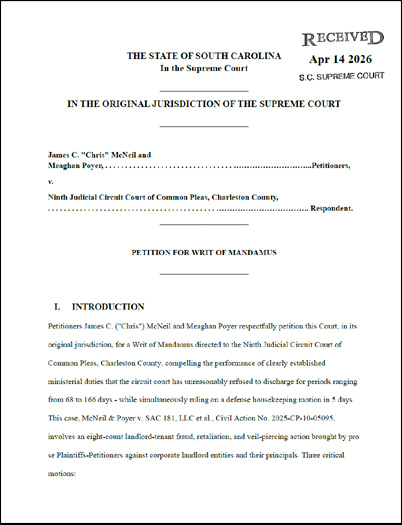
South Carolina Supreme Court, Appellate Case No. 2026-000919
Date: April 14, 2026 (Received by SC Supreme Court)
Document: Petition for Writ of Mandamus
Contents: 33-page petition documenting the 166-day unruled Motion for Leave, 91-day unruled ADA request, 5-day defense motion turnaround, two fabricated continuances, PCL-5 score of 76/80, and comparative docket analysis proving 4.3x statistical outlier status.
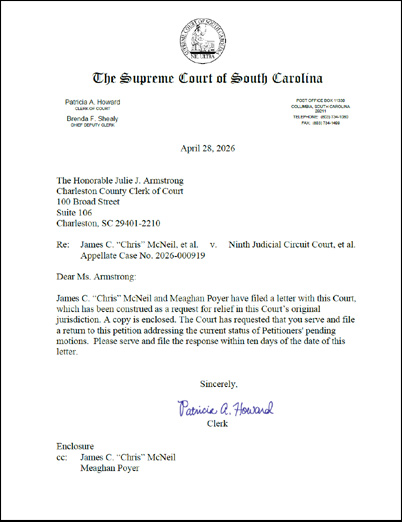
South Carolina Supreme Court, Appellate Case No. 2026-000919
Date: April 28, 2026
Document: Return Request Letter from SC Supreme Court Clerk Patricia A. Howard
Contents: Directs the Charleston County Clerk of Court to "serve and file a return to this petition addressing the current status of Petitioners' pending motions" within ten (10) days. Copies directed to Judge McCoy, Judge Rode, and Chief Administrative Judge Van Slambrook.
Executive Summary
The Supreme Court Intervenes in a Captured System
In South Carolina jurisprudence, a Writ of Mandamus is an extraordinary court order commanding a government official, agency, or lower court to perform a mandatory, non-discretionary public duty they have failed or refused to do.
In the South Carolina legal system, a Writ of Mandamus is an extraordinary, rarely granted remedy, where the Supreme Court of the state commands a government official, agency, or lower court to perform a duty they have failed or refused to do. yet the SC Supreme Court just responded to Plaintiff's Petition for Writ of Mandamus by issuing a Return Request to the 9th Circuit Charleston County Court of Common Pleas, a significant tactical victory, especially for a self-represented party.
And, given that a Writ of Mandamus is used only when a lower court functionally collapses and refuses to perform its basic, non-discretionary duties, the fact that the SC Supreme Court saw the need for the Return Request is yet another red flag marking thefriction in vulnerable people's access to justice in Charleston, SC.
The case McNeil v SAC 181, LLC et al (Charleston Common Pleas 2025-CP-10-05095) initiated September 9, 2025. As of May 6, 2026 - 239 days later - there has not been one single Plaintiff Motion heard.
Plaintiff McNeil was gaslit by multiple, coordinated defense parties with the facilitation of court staff in a campaign indistinguishable from a psychological abuse attack, until he had a nervous breakdown in late January and concurrent 76/80 PCL-5 "extreme" PTSD score - a level expected in long term victims of physical violence or a soldier coming off a battlefield.
Meanwhile, the Ninth Circuit Court of Common Pleas has effectively bolted this case to the floor. While routine defense requests were processed in mere days, the pro se plaintiffs were subjected to a total judicial blackout: zero motion hearings, 90+ days of ignored ADA accommodation requests for a defense-inflicted disability, and fabricated continuances that shielded defendants from accountability.
The local environment has proven so hostile that plaintiffs were forced to request the formal recusal of Judge Jennifer McCoy, who subsequently ignored the deadline to respond, which is necessitating further motion practice.
Faced with a captured local system actively stonewalling justice, the plaintiffs bypassed the appellate ladder entirely and petitioned the State’s highest court: The South Carolina Supreme Court.
The response was swift.
This Supreme Court has stepped in to force a fractured local system to expose its own docket disparities to the light of day. Just fourteen days after receiving the petition, the South Carolina Supreme Court took the exceptionally rare step of issuing the Return Request - ordering the Charleston County Clerk of Court and the presiding judges to formally answer for the months of silence.
The Data the Supreme Court Now Has
The petition didn't just argue unfairness. It provided the Court with its own system's performance metrics - the kind of data a court administrator would use to diagnose a procedural bottleneck. Specific findings:
| Motion | Filed | Days Unruled (at petition) | Opposed? | Ninth Circuit Median |
|---|
| Motion for Leave to File 2nd Amended Complaint | Oct 24, 2025 | 166 days | No (for 157 of 166 days) | 39 days |
| ADA Accommodations Motion | Jan 30, 2026 | 68 days | No | N/A (mandatory) |
| Relief in Omnibus Motion | Feb 24, 2026 | 42 days | No | N/A |
| Defense Motion to Relieve Counsel | Apr 2, 2026 | 5 days (granted) | N/A | N/A |
No single judge is assigned to this case. Motions rotate among the judges of the Ninth Circuit. This means the failure is institutional - multiple judges have had occasion to act, and the court as a system has failed. The petition framed this explicitly: when a system produces uniform non-response regardless of which individual occupies the judge's seat, the problem is not personnel. It's design.
The Supreme Court's Return Request - ordering the Clerk to "address the current status of Petitioners' pending motions" - responds to exactly this framing. It asks the system to report on itself. That is how supervisory oversight functions: not by punishing individuals, but by restoring information flow to a subsystem that has gone dark.
What This Means for Other Pro Se Litigants in South Carolina
If a court can remain silent for 210 days on an unopposed motion from an unrepresented party while processing represented parties' motions in 5 days - and face no supervisory correction - then the right of self-representation guaranteed by the South Carolina Constitution is a right without a remedy. You have the right to represent yourself, but the system may simply stop responding to your filings. Your right exists in theory. In practice, you wait.
This petition establishes a documented precedent: when that silence reaches a critical threshold, the Supreme Court will intervene. The Return Request is the evidence that the supervisory mechanism works - that a pro se litigant can activate it with data rather than connections.
The Housing Justice Audit documents the broader system this case operates within - the feedback loops between property management practices, court administration, and tenant vulnerability. The Mandamus petition is the mechanism that makes one of those feedback loops visible to the authority responsible for its health.
If you are a self-represented litigant in South Carolina experiencing a similar pattern of administrative non-response, the data methodology used in this petition - comparative docket analysis, median processing times, statistical outlier identification - is publicly available and replicable. The system responds to data. This case proves it.
What does the Return Request from the SC Supreme Court State?
The Return Request is addressed to:
The Honorable Julie J. Armstrong
Charleston County Clerk of Court
and states,
Re: James C. “Chris” McNeil, et al. v. Ninth Judicial Circuit Court, et al.Appellate Case No. 2026-000919
Dear Ms. Armstrong:
James C. “Chris” McNeil and Meaghan Poyer have filed a letter with this Court, which has been construed as a request for relief in this Court’s original jurisdiction. A copy is enclosed. The Court has requested that you serve and file a return to this petition addressing the current status of Petitioners' pending motions. Please serve and file the response within ten days of the date of this letter.
Sincerely,
Patricia A Howard
Clerk
Enclosure
cc: James C. “Chris” McNeil
Meaghan Poyer
Why This Petition Beat the Odds: Overcoming the "Extraordinary Remedy" Bar
In South Carolina, a Writ of Mandamus is known as the "highest judicial writ." It is notoriously difficult for tenants or pro se litigants to win because the Supreme Court actively avoids micromanaging local judges. To force the Supreme Court to intervene, our Petition had to overcome three massive legal hurdles by using the court's own undeniable data:
- Discretion vs. Ministerial Duty: Mandamus cannot be used to tell a judge how to rule (discretion), only to force them to perform a mandatory duty when they refuse to act at all. Our Petition didn't ask the Supreme Court to weigh evidence. Instead, it documented a 166-day delay on an unopposed motion to amend (which the rules say "shall be freely given") and a 68+ day delay on a federally mandated ADA accommodation request[cite: 94, 95]. We proved the local court wasn't exercising discretion; it was refusing to perform its basic, ministerial duties for an unrepresented litigant, while approving defense motions in just 5 days.
- The "Alternative Remedy" Bar: The Supreme Court usually dismisses these petitions by telling litigants to wait and file a normal appeal after the trial. We proved that the normal appellate ladder was fundamentally broken. Because the Ninth Circuit simply stopped issuing rulings on our motions, there was nothing for us to appeal. The system's silence made Mandamus our absolute last and only resort.
- Original Jurisdiction (The Public Interest Test): To bypass lower courts entirely, a petition must involve "significant public interest" or "unusual circumstances". We didn't just frame this as a personal grievance. We tied the 33:1 motion processing disparity to systemic "access to justice" failures. Furthermore, we exposed the deep conflicts of interest at play, noting that the beneficial owner of the defendant corporation also sits on the Mayor's Affordable Housing Commission - elevating a tenant exploitation case into a matter of urgent, city-wide public integrity.
The Two Continuances: How Fabricated Consent Bought 160 Days
The 210+ day silence did not happen by accident. 160* of those days were enabled by two separate continuances - each secured under demonstrably false pretenses.
The first continuance appeared based on claimed plaintiff consent that was not given, and in spite of an opposition filed by Plaintiffs that clearly demonstrated the falsehood. The second referenced the need for a ruling that Chief Administrative Judge Van Slambrook had already made at the February 9 scheduling hearing. The net effect was indefinitely postponing the need for defense to face a motion hearing and account for maintaining a false frame of the case and engage the actual evidence and allegations.
Without the first continuances, motion would have been heard December 9, 2025. The second hearing would have been April 3, 2026. With them, defense counsel purchased the exact conditions their exhaustion model requires: seemingly unlimited time, zero accountability, and a plaintiff whose health was already compromised forced to stay on hold under the weight of indefinite limbo.
That's how the Charleston, SC Court of Common Pleas has enabled lawfare against an unrepresented party. The continuances create the space for defense plaintiff harassment and exhaustion tactics. It appears typical that exhaustion enables a quiet settlement that is not only unjust but fails to rebalance the system.
Every link in that chain is now broken. The continuances are documented. The silence triggered Supreme Court intervention. The exhaustion produced commitment rather than surrender. And the settlement option is permanently off the table.
What remains is the evidence - and twelve jurors who will evaluate it without any interest in maintaining the pattern.
*160 days will have passed since the original scheduled hearing with Judge Thomas Rode on December 19, 2025 when the upcoming hearing with Judge Will Wheeler (just scheduled) occurs on May 28, 2026.
What Comes Next
The Return Request gave the Charleston County Clerk ten days to respond. That return will either confirm that the motions remain unruled - triggering potential further Supreme Court action - or report that the system has begun to self-correct under the light of supervisory attention.
Either outcome advances the same principle: when institutional silence functions as a de facto bar to justice, the supervisory system has a duty to restore function. This is not punishment. It is maintenance. And it is now underway.
For questions about the SC Supreme Court's intervention in this case, contact:
Chris McNeil, Pro Se Plaintiff
Email: Click here to email with web form
Case: 2025-CP-10-05095, Charleston County Court of Common Pleas
Document Access
Petition for Writ of Mandamus — SC Supreme Court Original Jurisdiction (April 14, 2026)
To Top
 Unable to view the pdf on your mobile device?
Download the PDF
SC Supreme Court Return Request Letter — Appellate Case No. 2026-000919 (April 28, 2026)
To Top
 Unable to view the pdf on your mobile device?
Download the PDF